Top and back assembly for the SSJ model is completed. I did cross section shaping for the back to minimize weight. I will trim the brace high at edge portion a little more when I install the back to the body. For the top, I increased X-bracing opening angle from 88-frgree to 93-degree. Original Taku's bracing pattern has shown good results from last two SSJ built. I do not want to change a lot. However, I want to slightly increase overtones for bass-E string. Therefore, I increased the X-opening slightly. I will also change the scalloping pattern for bass side. Taku's original scalloping pattern is asymmetrical. He on-purposely reduced scalloping on buss side to reduce overtone generation. I will increase the scalloping on buss side to increase overtones.
Kohei Fujii Guitars
Sunday, January 26, 2014
Sunday, January 19, 2014
SSJ Bracing
I made bracing materials. First photo shows a cross section of my X-bracing. I always shave out top braces as concave. This shaving requires extremely long time. This extra effort might contributes very tiny part of sound quality; however, very tiny differences pit together makes excellent tonal quality. That is why a properly built hand made guitar creates excellent tone.
2nd photo is for the X-brace installing sequence using the vacuum clump system. This technique enables a void free glue joint. The last photo is for the completed Rosetta. I installed a Hawaiian Koa inner ring to make a lovely flamed border. Inner ring also seals well for moisture penetration into the top wood.
Sunday, January 12, 2014
Lattice Back Bracing
As I mentioned on the previous blog, I am using the lattice bracing for the sound board for my Nylon model. I also use the lattice bracing for my back. This time, I will use very thin back board thickness. Back thickness is 2mm for SSJ and 1.8mm for Nylon. When the back board thickness is very thin, ladder bracing stricture will be visible. This is a serious problem for loosing the beauty of back dooming shape. However, thinner back board improves guitar's sound response. Earvin Somogyi mentioned this fact in his book, "Making the responsive guitar". I agree with his comments. To make thinnest possible back board thickness without sacrificing back dooming shape, I employed the lattice bracing for the back. First photo is for the nylon model. This is a gluing sequence using a vacuum clumping system. 2nd photo is the completed back for the nylon model. I was able to obtain very beautiful 12' radios without any distortion issue for the 1.8mm back thickness. Last photo is for the SSJ back. This is before gluing for the lattice. SSJ model uses Spanish ceder for the lattice bracing material.
Sunday, January 5, 2014
SSJ 6-strings built
I have a new project for making a 6-strings SSJ model. This guitar has a premium grade of an European spruce top and Guatemalan Rosewood back and sides. Guatemalan RW is a quite lair material. Looks pretty much the same as Honduran RW. However, Guatemalan RW has a bit glassier tap tone. I made a custom Rosetta using King wood, Asian Ebony, and Oregon Myrtle. I finished back joint using African black wood for the center strip. I also finished thickness sanding for top, back, and sides. Next week, I will do bracing installation for back and top.
Sunday, December 29, 2013
New Lattice Bracing Nylon Strings Guitar Design
I have a new project for an experimental nylon strings model. My goal is to make a guitar that has steel strings guitar like over tones using nylon strings. I am designing a guitar for Jazz and contemporary musicians. My
assumption is using an electrical pick-up system; therefore, my design does not
need loud voice. To generate a lot of over tones, I selected a lattice bracing design. A picture shown below is my new lattice bracing top. This has 5x5 lattice bracing configuration using 3mm thickness Sitka spruce. To make the brace lighter, I shaved as V-cross section. I also scalloped the lattice bracing. Lowest scalloped portion is at a little bit below the bridge. I want to make flexible portion at below the bridge to realize a cantilever like movement for the bridge. This top design might be able to create rich over tones effectively. I have never seen the top design like this.
Unlike my lattice bracing design, latest lattice bracing nylon strings guitars have Balsa wood bracing
with carbon fiber lamination using Epoxy resin. Those designs have less
than 1mm top board thickness with massive A-frame body using high
quality aerospace grade poly wood. This design was originally invented
by Greg Smallman. I do not believe the Smallman type design makes rich
over tones. His design improves efficiency for making more loud sound.
This means that his guitar works pretty effectively as a mechanical air
pump. Also, all of existing lattice bracing designs have the thickest (strongest) portion at the bridge, and tapered out to the top edges. This design makes much larger the top movement; therefore, the guitar works pretty effectively as an air pump to make loud sound. However, this design does not effectively contributes to generate rich over tones, because the bridge is very strongly coupled with the mechanically strongest top portion.
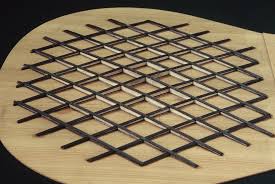
My new guitar making might requires six month to complete at least. Once I complete this design, I would like to post sound samples to show how well my design generates rich over tones like steel strings guitars.
This is my new lattice bracing pattern
Typical bracing design for Smallman type guitars
My new guitar making might requires six month to complete at least. Once I complete this design, I would like to post sound samples to show how well my design generates rich over tones like steel strings guitars.
Sunday, December 15, 2013
New built start
New guitar making projects start. This time, I make two SSJ 6-strings versions and one nylon strings model for me. Three of them have European spruce top with Adirondack spruce brace. I did a lot of wood mill work today. I cur Adirondack spruce log to real bracing materials. You may see the rough cut log for bracing material. Those are look like fireplace wood.
I also cut many wood straps for Rosetta making. Materials are Myrtle, King wood, and Ebony. Those materials glue together to make a colorful Rosetta for SSJ model.
Nylon model has an off-set sound hole, and Lattice bracing using the Adirondack spruce. Back and side materials are Amazon rosewood. Actuary this material was initially processed for the SSJ model; however, the wood quality is not good enough for my customers. I rejected this material. I will use this material for my experimental project.
I also cut many wood straps for Rosetta making. Materials are Myrtle, King wood, and Ebony. Those materials glue together to make a colorful Rosetta for SSJ model.
Nylon model has an off-set sound hole, and Lattice bracing using the Adirondack spruce. Back and side materials are Amazon rosewood. Actuary this material was initially processed for the SSJ model; however, the wood quality is not good enough for my customers. I rejected this material. I will use this material for my experimental project.
Saturday, November 30, 2013
MD re-setting and re-finishing
My previously completed guitar has a finishing material issue. I have experienced a curing issue using the Target EM7000 finishing material. This finish required extremely long curing time, and never get herd enough coat. You may see the second photo for the machine head scares. Those are clear evidences for how much finish has been sunken. Now, I am re-finishing using the EM6000 formula. I will spray one-hour/coat schedule. I spray 4 to 5 coat/day, and total 8 to 10 coats I apply. This makes pretty good results for me.
I shipped this guitar to Japan. There is a big humidity difference between California and Japan. Due to the high humidity, this guitar needed to use a strong truss-rod adjustment. To minimize the truss-rod tension, I re-installed fret wires without removing fret wire tings. This makes reverse neck curve to compensate the string tension. In California, this setting makes string action too low; however, the setting for Japan is quite different. I have learned from this lesson.
Subscribe to:
Posts (Atom)