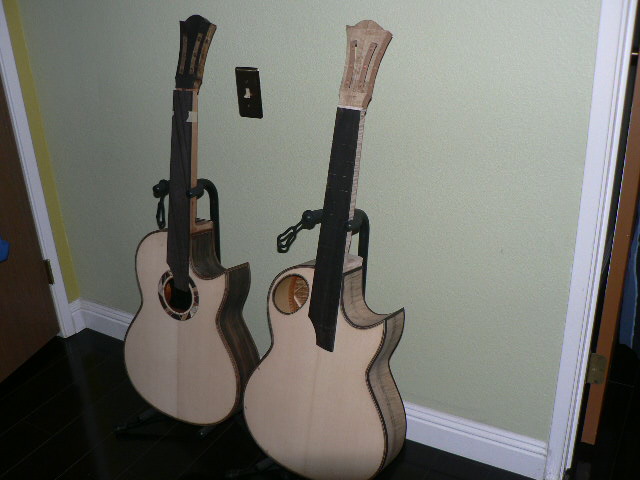
Neck shaping is my most fun process. I really like the neck shaping. I have learned from Late Taku Sakashita for the neck shaping technique. Once I know how to shape the neck, I am able to complete the shaping work within one our. Also, I am able to shape identical two necks using the Taku's method. This time, I shaped a maple neck. This maple material has strong fiddle-back flames. I expected that this neck shape is a quite tricky one. Fortunately, the maple neck shape was not so difficult. It spend a little bit more time than the traditional Mahogany or Spanish ceder neck shaping. I also completed the fingerboard leveling work. Finger board leveling is a tricky work, because I have to predict how much the neck bowing will occur. Nylon strings guitar neck needs decent neck forward bowing. Also, higher fret positions above the 12th fret need a negative tapering to prevent a buzzing problem. This time, to make a neck bowing strong, I on-purposely installed the truss rod or Graphite rod at below 3-frets. I made the neck more flexible above 3frets. This makes an optimum neck bowing.
Next week, I will install fret wires, and then I will have the final sanding.
Kohei Fujii Guitars
Sunday, July 26, 2015
Sunday, July 19, 2015
Truss rod install and neck shape
I did truss rod install for both the Myrtle and the Negro models. The Myrtle model has a graphite non adjustable truss rod. The negro model has a double action adjustable steel truss rod. The Myrtle model has an offset sound hole, and there is no place to make an access hole for the adjustable truss rod. So, I changed my design to the non adjustable design. For the fingerboard installation, I have been using the rubber shock code for sailing boats. The shock code makes the best result to make perfect bond between the neck and the fingerboard particularly for the radiused fingerboard installation. Now, I am working on the neck shaping. My neck has 21.5mm thickness at the 1st fret and 23mm thickness at the 10th fret.
Sunday, July 12, 2015
Neck joint and Fingerboard built
Neck joint to the body and the finger board making have been done. Both two models have African black-wood finger boards. It takes extra time for slotting work due to the oily and heard material property. However, the African Black wood makes the best play-ability. I also have spent a lot of detailed work for the best neck fitting. I have been using the mortise neck joint method. I used the Epoxy for the Mortise joint. Finger boards have not been installed. Finger board installation requires additional fitting work, because the body top is domed. So, the finger board needs to be shaped to fit the body top doming. Then, finger board needs a bowing work for the neck re-leafing. These guitars might require additional three weeks for the finishing work.
Sunday, June 28, 2015
Body constraction complete and mortise cut
Both Myrtle and Malaysian BW bodies are completed. I also cut mortises for the neck and the body joint. Both bodies showed extremely long-time lasting tap tone. Center sound hole body has much higher resonant frequency than the off-set body. Location of the sound hole changes the fundamental resonate frequency. Due to the longer physical length of the available surface, the off-set sound hole body shows much lower tap-tone frequency. This lower fundamental resonant frequency makes more strong buss. So, I will use 24.9" strings scale for the off-set sound hole body. Shorter string scale improves play-ability. However, shorter strings scale lowers the string tension. To overcome the low tension issue, I will use the super high tension strings for the offset body. As a result, the offset-body makes super easy playing guitar without sacrificing the sound quality. This guitar is going to be my new Jazz nylon model.
I will use the 25.4" strings scale for the center sound hole design (Malaysian BW). 25.4" scale is still a relatively short as the standard Classical guitar that has normally 25.59" scale. This body is using a super responsible lattice brace with only 1.6mm minimum sound board thickness. My sound board has different thickness depending on the location. This super responsible sound board does not need the long strings scale to drive the top to generate over tones. So, the center sound hole model is also the player friendly guitar with optimum over tone balance.
Sunday, June 21, 2015
Binding install
Binding installation for nylon models are completed except the cut-a-way portion. Myrtle body has the African black-wood binding. Malaysian black-wood body (Negro) has the Bocote binding. Both materials bend pretty easy. The most difficult binding material for bending is Ebony. Ebony is super brittle. Previously, I have been using the Ebony binding. However, I am tired of using the super brittle material. Particularly, the cut-a-way portion is pain-in-the-ass. For me, the African black wood is the best material for the binding. It bends well, and looks excellent. Only drawback is the high price.
Sunday, June 14, 2015
Body detailed work
Purfling materials are made using Black-white-Brazilian RW-white combination. Purfling installation is also done. Remaining process for the body construction is the binding installation.
Maple neck making has also made a lot of progress. Head stock shaping is complete. Head veneer is Myrtle. Machine head holes are also drilled. Both maple neck and Mahogany neck will install two way truss rods. I will use super high tension strings for those guitars. Conventional no re-reinforced neck is not able to maintain the neck straight shape if one uses high tension strings. When the nylon strings guitars are new, a little bit extra bowing for the neck and finger board requires occasionally. If so, I have to remove all frets and I need to re-shape the finger-board. It is an extremely time consuming process. To improve the neck set-up time and quality, I will install the two-way truss rod. The two-way truss rod is able to bend the neck both forward and reverse bend. Also, the truss rod is able to greatly improve the future neck maintenance quality.
Sunday, May 31, 2015
Closong box and Neck making
Negro body was closed. Before closing the box, I added Graphite filament epoxy laminated patches at cross sections on the lattice brace. This makes the lattice brace more stable and strong with minimum weight increase. Before closing the box, I also applied three coats of shellac for the top and the back. After closing the box, I start making a neck. This is a three piece laminated Maple neck using the V-joint for the head joint. To make square slots for the tuning machines, I cut-out the slot first including the head itself. Then, I glue back to make the square slotted head. The head will be V-jointed to the neck. This maple neck material has pretty nice flames. I will use this neck for the Myrtle body.
Subscribe to:
Posts (Atom)