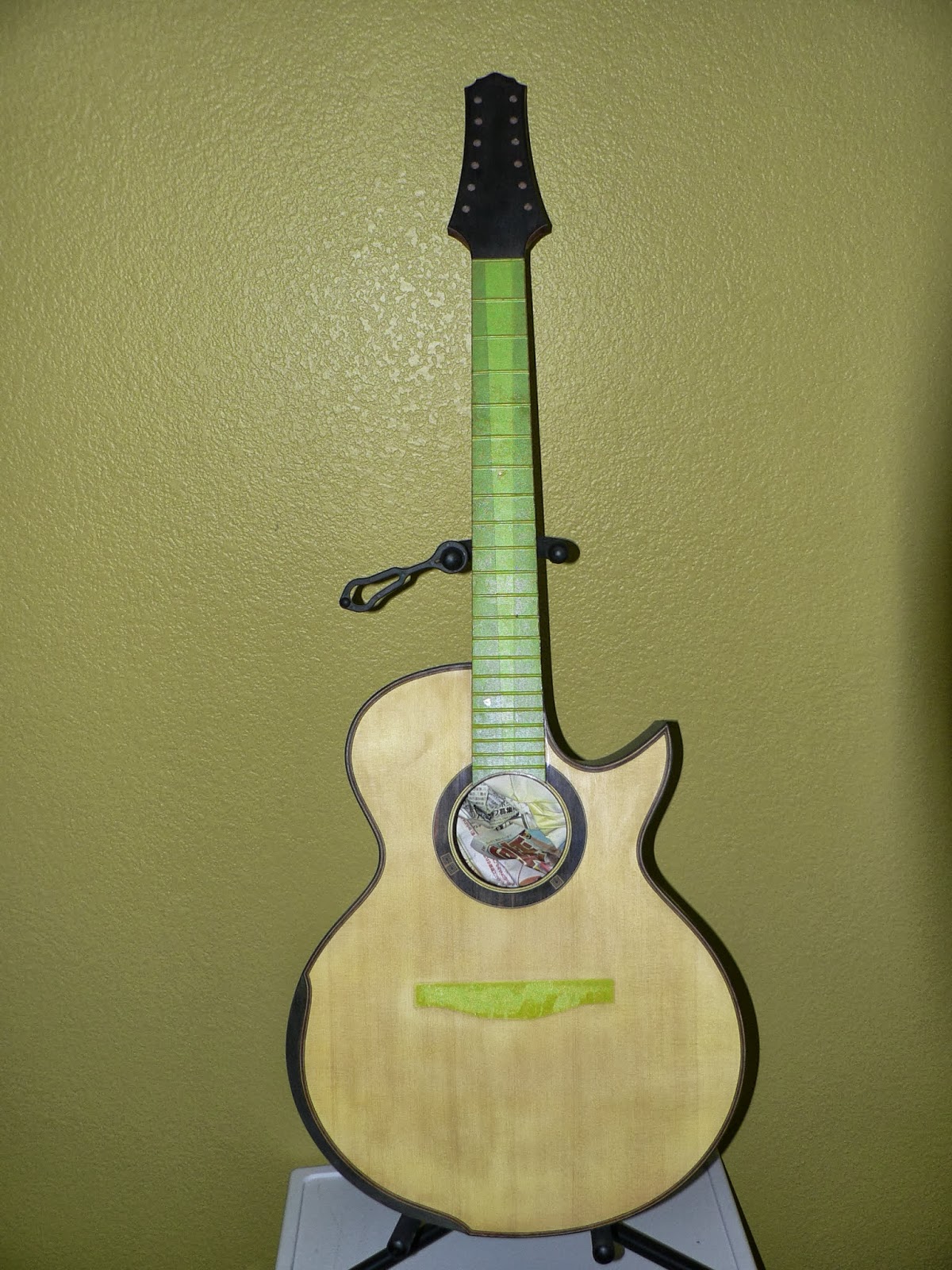
New guitar making projects start. This time, I make two SSJ 6-strings versions and one nylon strings model for me. Three of them have European spruce top with Adirondack spruce brace. I did a lot of wood mill work today. I cur Adirondack spruce log to real bracing materials. You may see the rough cut log for bracing material. Those are look like fireplace wood.
I also cut many wood straps for Rosetta making. Materials are Myrtle, King wood, and Ebony. Those materials glue together to make a colorful Rosetta for SSJ model.
Nylon model has an off-set sound hole, and Lattice bracing using the Adirondack spruce. Back and side materials are Amazon rosewood. Actuary this material was initially processed for the SSJ model; however, the wood quality is not good enough for my customers. I rejected this material. I will use this material for my experimental project.
Kohei Fujii Guitars
Sunday, December 15, 2013
Saturday, November 30, 2013
MD re-setting and re-finishing
My previously completed guitar has a finishing material issue. I have experienced a curing issue using the Target EM7000 finishing material. This finish required extremely long curing time, and never get herd enough coat. You may see the second photo for the machine head scares. Those are clear evidences for how much finish has been sunken. Now, I am re-finishing using the EM6000 formula. I will spray one-hour/coat schedule. I spray 4 to 5 coat/day, and total 8 to 10 coats I apply. This makes pretty good results for me.
I shipped this guitar to Japan. There is a big humidity difference between California and Japan. Due to the high humidity, this guitar needed to use a strong truss-rod adjustment. To minimize the truss-rod tension, I re-installed fret wires without removing fret wire tings. This makes reverse neck curve to compensate the string tension. In California, this setting makes string action too low; however, the setting for Japan is quite different. I have learned from this lesson.
Sunday, November 24, 2013
MD and SSJ complete
Both SSJ 12-strings and MD are completed. I already shipped the 12-strings to the client.
I did side by side comparison between previously made guitars and new African black-wood versions for both SSJ and MD. Both ABW models showed much brighter tonal quality than Brazilian RW or King wood. Form these experiences, I could say that the ABW has the best tonal quality for the steel-strings guitars. Difference is quite small; however, ABW has an unique sound character. Only ABW makes this kind of brightness and rich over tones. This was my surprisingly interesting experiences. Yes, ABW makes some of the best sound qualities, however, this material gives me a lot of problems and challenges. ABW has so many defects. ABW is super oily and very herd to drum sand. ABW is brittle. ABW is heavy. ABW is very expensive.
Sunday, November 10, 2013
12 strings guitar test
12 Strings SSJ model is completed except an electrical pick-up system installation. I also forget to order the 12-strigs set. So, I tested as a 6-strings set-up. Although the top has slightly thick board thickness for 12-strings configuration, this guitar generated amazingly nice sound. After a year of playing, this guitar will fully open-up to generate rich and loud sound. This model employed an hybrid bridge design to minimize bridge weight. This bridge looks like a 6-strings bridge; however, there are 6-additional strings support at bottom.
Sunday, November 3, 2013
Final sanding and polishing
After two weeks of resting for both MD and SSJ, two guitars are ready for final sanding and polishing. I started with 600-grit sanding following 1200-grit and 2000-grit sanding. I sanded with water with couple of drops hand soap to keep sandpaper fresh. Then, both guitars are polished using a polishing compound. Now, both guitars are completed rough polishing sessions. Both guitars need hand polishing sessions using a super fine grade polishing compound. Next week, I might be able to install bridges to both guitars.
Tuesday, October 15, 2013
Final coat apply
Finally, the final coats are applied. I used Target EMM6000 water based acrylic finish. Last time, I used the EMM7000HB with some troubles. EMM6000 is so much easy to control for me. This time, I have gotten very satisfied results, and I am pretty happy. Two guitars need two weeks to cure the finishing, and then I will take surfacing and polishing.
Sunday, October 6, 2013
Epoxy filler sanding and Yellow stain apply
Sanding for the Epoxy filler is done. I did two sessions for the neck filler apply, and one session for the body and the top. After finishing the sanding session, I applied Yellow stain on top for both models. Yellow stain is very light color; however, it is enough to make an impressive beauty.
Subscribe to:
Posts (Atom)